Apr 30, 2026
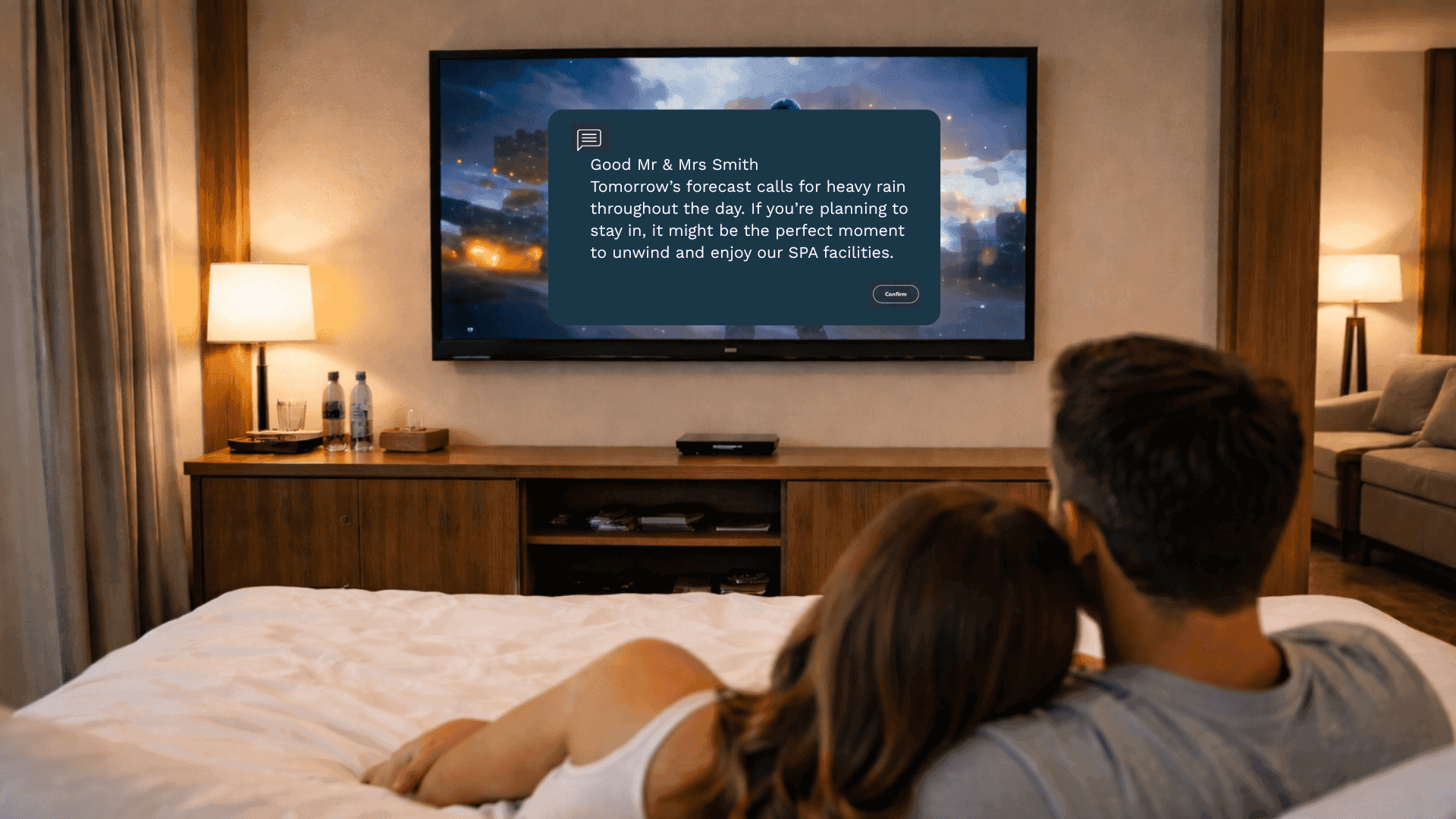
For years, the in-room entertainment system has been a largely passive element within the hotel. It’s there, it serves a basic purpose, and it rarely enters any meaningful strategic discussion. In the mid-scale segment, this is even more pronounced: the focus tends to be on operational efficiency, cost control, and delivering a solid, no-frills guest experience.
But the context has shifted. Not because the technology itself has dramatically evolved, but because guest behavior has. And that shift is forcing a rethink of the role TV plays inside the room.
1. Understanding the starting point
Mid-scale hotels operate under a very specific logic: lean teams, optimized processes, and little room to add complexity. Any technology introduced into daily operations needs to prove its value quickly. It’s not enough for it to simply work; it has to contribute.
In this context, many TV systems are still anchored in a model that no longer reflects how guests behave. Clunky interfaces, generic content, limited personalization, and—most importantly—no connection to the rest of the hotel’s ecosystem. The outcome is predictable: low usage and no real business impact.
The real issue isn’t that the TV is underused. It’s that it sits completely outside the guest journey.
2. The room as a moment of decision
Today’s guest doesn’t arrive at the hotel to “discover” the destination from scratch. They arrive with part of the trip already planned—but with plenty of decisions still open. And those decisions aren’t made at the front desk or while walking around the city. More often than not, they happen in the room.
It’s a quiet moment, free from pressure, where guests organize their time: what to do that afternoon, where to have dinner, whether to use a hotel service or head out. That space—the room—has become a far more relevant decision point than it has traditionally been considered.
This is where the entertainment system can evolve. Not as a content catalog, but as an interface that supports that moment.
3. From content to utility
Traditionally, the in-room TV has been positioned as a content channel: more channels, more options, more information. But that’s not what the guest is really looking for. What they need is much more specific: clarity when making decisions.
When the system is well designed, its value doesn’t come from the number of options it offers, but from its ability to simplify concrete decisions.
In practice, this translates into three areas with direct impact.
First, reducing operational friction. A large share of front desk interactions still revolve around basic information—opening hours, services, recurring questions. Making that information easily accessible on the TV reduces unnecessary calls and frees up staff time.
Second, activating in-hotel consumption. Many decisions around dining, spa, or additional services happen in the room. It’s not about pushing offers, but about being present when the guest is weighing options. A system that supports that moment, with well-contextualized suggestions, can drive incremental revenue without adding commercial pressure.
And third, connecting the guest with the destination. This is probably one of the most underutilized areas. Guests are constantly thinking about what to do outside the hotel, yet they rarely find useful support from within the room itself. Filtering options, simplifying choices, and adapting to context—time of day, weather, length of stay—adds far more value than any endless list of recommendations.
4. The critical point: experience and operations
One of the most common mistakes in these projects is focusing only on the guest experience without considering internal operations. In mid-scale hotels, this is especially sensitive.
If the system requires constant maintenance, relies too heavily on IT, or turns content updates into a complex task, it quickly loses traction. Not because it lacks value, but because it isn’t sustainable.
That’s why, beyond features, three aspects should sit at the center of any decision:
Ease of day-to-day management. Hotel teams need to be able to update and adapt the system without friction.
Integration with other systems. Without connection to the PMS or other tools, personalization and automation remain limited.
Scalable evolution without structural cost. Improving or adapting the system shouldn't require rethinking the entire infraestructure.
5. Streaming, privacy, and expectations
There’s another factor that can no longer be overlooked: access to streaming platforms. Guests take it for granted, yet its implementation still creates friction.
Open Smart TV solutions offer flexibility, but they also introduce clear risks around privacy and management. On the other hand, more controlled systems can deliver a smoother, more guided experience—provided access is simple and credential deletion is fully automated.
There’s no single solution here, but there is a clear principle: the experience must be effortless for the guest and secure for the hotel, without adding operational burden.
6. Where to start—without adding complexity
There’s no need to overhaul everything from day one. In most cases, it’s far more effective to focus on specific moments within the guest journey.
Arrival and the end of the day are key touchpoints, when guests are more receptive. Identifying the decisions that happen in those moments—and making sure the system is present in a useful, relevant way—is often enough to start generating impact.
From there, tracking actual usage—not just availability—allows the system to be refined and evolved progressively.
In the mid-scale segment, the in-room entertainment system doesn’t need to be more sophisticated—it needs to be more relevant..
When it stops being a static element and becomes part of the moments when guests make decisions, its role changes completely. And with it, its impact on both the guest experience and hotel operations.
Industries
Hospitality
IPTV/OTT operators
Content owners
Sports platforms
Contact
info@yuvod.com
