Feb 27, 2026
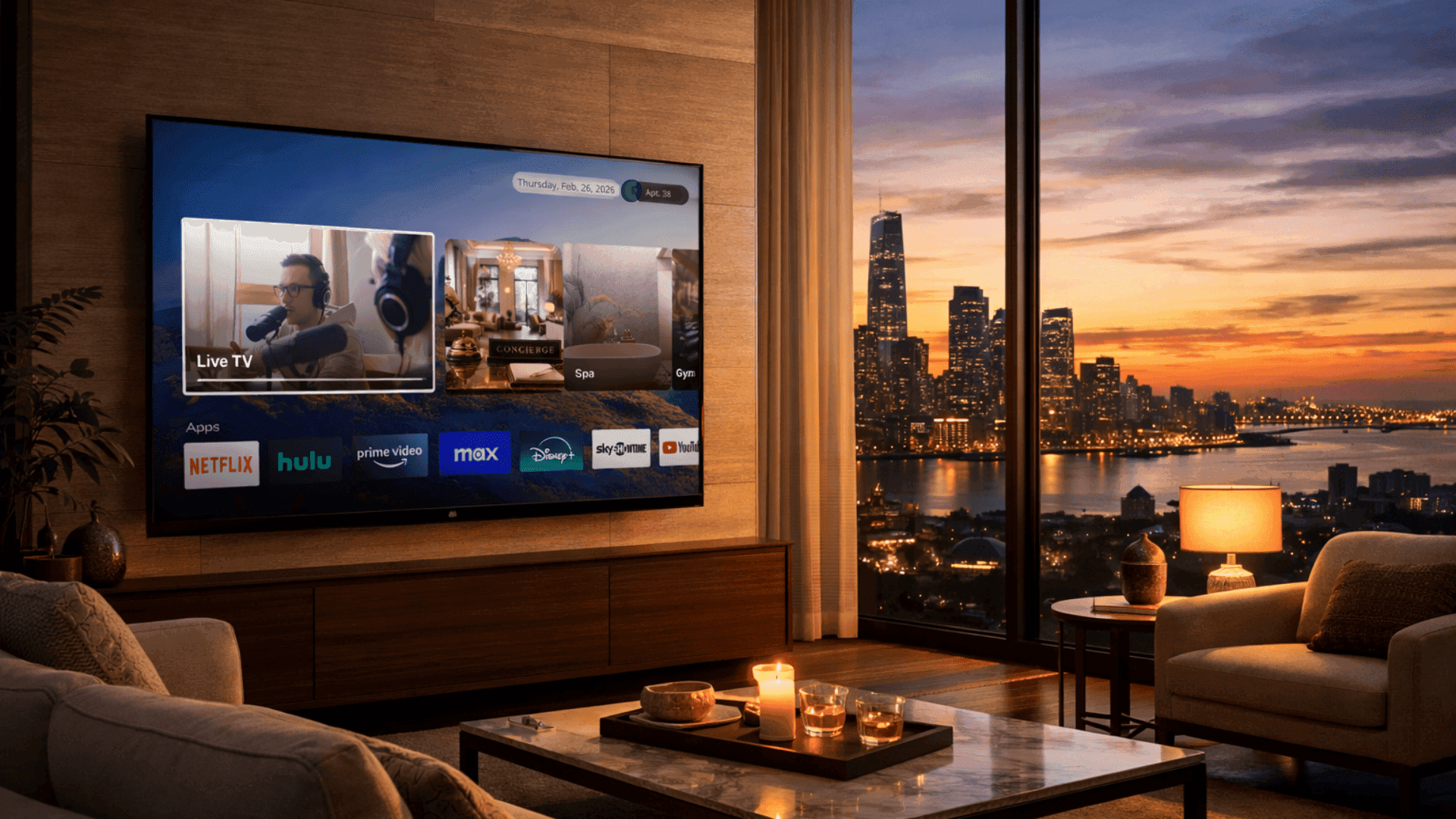
The global growth of branded residences is reshaping the relationship between hospitality and high-end real estate. What began as a natural extension of hotel brands into the residential sector has evolved into one of the most promising segments within the luxury market.
Yet there is a dimension that still lacks sufficient analysis: branded residences technology.
Because when a private residence operates under hotel-level standards, technology is no longer a complement — it becomes critical infrastructure.
1. The Rise of Branded Residences and Their Technological Impact
Branded residences are residential developments affiliated with international hospitality brands such as Four Seasons, Marriott International, or Mandarin Oriental.
They may be integrated within a hotel property or operate as standalone assets managed by the brand. From a market perspective, this model responds to three structural forces:
Investors seeking assets backed by a globally recognized brand
Buyers who prioritize services and experience over traditional ownership
Operators looking to diversify revenue streams beyond RevPAR
However, this hybrid model introduces a new variable: the need for a residential hospitality tech stack capable of operating sustainably over the long term — not just during short-term stays.
2. Residential Hospitality Tech: An Ecosystem Designed for a New Reality
In a traditional hotel, technology revolves around clearly defined stay cycles.
In a branded residence, however, multiple profiles coexist:
Permanent resident owners
Owners participating in a rental program
Short-term guests
Shared services with the hotel
Real estate management and property administration
This complexity requires a different technological architecture — one designed to adapt to overlapping operational models and long-term occupancy patterns.
Residential hospitality tech must enable:
Advanced segmentation by profile and occupancy type
Integration with hotel PMS and residential property management systems
Long-term scalability
Remote updates without physical intervention
A consistent experience aligned with the brand promise
Within this technology stack, the digital TV system plays a far more strategic role than is often recognized.
3. Digital TV Systems for Branded Residences: From Passive Screen to Strategic Infrastructure
In a traditional hotel environment, digital TV is typically associated with entertainment and basic guest communication. In a branded residence, the context changes dramatically.
The screen in the living room or bedroom becomes the most stable — and least intrusive — point of contact with the resident.
A well-integrated digital TV system for branded residences can function as:
An on-demand service hub
A segmented communication interface
An operational update channel
A digital extension of the brand within the home
This is no longer about promotion. It is about service infrastructure embedded directly into the residential environment.
3.1 Technology for Branded Residences: Intelligent and Segmented Communication
One of the main challenges in branded residences is avoiding generic communication — not everything is relevant to every profile.
Technology must enable:
Exclusive messaging for owners
Tailored information for units enrolled in the rental program
Maintenance communications
Targeted activation of premium services
A digital TV system integrated with the PMS and CRM allows true segmentation by unit, stay type, or resident profile.
The result is reduced operational friction and a more refined, personalized experience — aligned with the standards expected in a branded residential environment.
3.2 Protecting Long-Term Asset Value Through Cloud-Native Technology
Branded residences are high-value real estate assets designed to last for decades.
The technology deployed within them cannot become obsolete in five years. A cloud-native system enables:
Remote updates without hardware replacement
Seamless adaptation to rebranding or brand evolution
Future integration with emerging PropTech solutions
Scalability across multi-location developments
In this context, technology for branded residences must be conceived as part of the asset strategy — not as an additional layer of equipment.
3.3 In-Room Technology for Luxury Residences: Frictionless Experience
In branded residences, technology must remain invisible when it is not needed.
Residents are not looking to accumulate apps or navigate complex digital flows.
And they certainly do not want to feel commercial pressure within their private environment.
What they do value is:
Easy access to concierge
Booking internal services
Requesting housekeeping
Communicating with property management
Accessing relevant building information
In-room technology for luxury residences must stay out of the way until required — and activate seamlessly when needed.
A fully integrated digital TV system fulfills precisely that role: present, stable, and intuitive, without disrupting the residential experience.
3.4 Operational Data in Mixed-Use Developments
In projects that combine hotel and residential components — mixed-use developments — technology becomes the operational bridge between both worlds.
A digital TV system connected to the broader tech stack enables operators to:
Analyze service usage
Measure activation of internal services
Identify behavioral patterns
Optimize operational resources
All under strict privacy and compliance standards, technology introduces strategic visibility into an environment that has traditionally been opaque from a data perspective.
3.5 IT Efficiency in Luxury Residential Environments
One of the major challenges in branded residences is technological stability. Permanent residents have very low tolerance for technical failures.
An integrated architecture enables:
Reduced manual intervention
Lower dependence on physical updates
Centralized maintenance
Technological consistency between hotel and residential components
Stability is no longer just a technical matter — it becomes a perception of quality.
In luxury residential environments, seamless technology is not noticed when it works. But when it fails, it directly impacts brand credibility.
4. Branded Residences Technology as a Competitive Advantage
The global expansion of branded residences will continue across prime urban markets and strategic leisure destinations. In this landscape, branded residences technology will become one of the key differentiators between developments.
Luxury is no longer defined solely by architectural design.
It is defined by:
Consistent experience
Seamless services
Integrated technology
Investment protection
Operational scalability
Within this ecosystem, the digital TV system is not an isolated device.
It is part of the architectural layer that sustains the branded residential hospitality experience — quietly supporting operations, reinforcing brand standards, and protecting long-term asset value.
5. Beyond Entertainment: Experience Infrastructure
A digital TV system should be understood as a structural component within the technology stack of any hospitality asset. Not as a standalone device, but as an integrated interface connecting operations, services, and experience.
In the context of branded residences, this approach takes on an even greater dimension. Here, the screen does not accompany a short stay — it becomes part of the resident’s daily life. And that nuance transforms its function.
Within the residence, the digital TV system can become a permanent touchpoint with the brand — frictionless, accessible, and free from additional technological layers. It can operate as an interface to activate on-demand services — from concierge and housekeeping to internal reservations — while also serving as a segmented communication channel that differentiates between owners, temporary residents, or units enrolled in rental programs, avoiding generic messaging that dilutes the premium experience.
When properly integrated into the asset’s technological architecture, it also becomes a source of meaningful operational insight: service usage patterns, activation moments, interaction with key functionalities. Data that enables operators to refine service offerings, optimize resources, and make more informed decisions.
In a model where hospitality evolves toward a concept of lifestyle and belonging, technology embedded within the residence cannot be treated as ancillary equipment.
It must be part of the asset’s strategic design from inception — at the same level as architecture, services, and the overall value proposition of the development.
Industries
Hospitality
IPTV/OTT operators
Content owners
Sports platforms
Contact
info@yuvod.com
