Dec 29, 2025
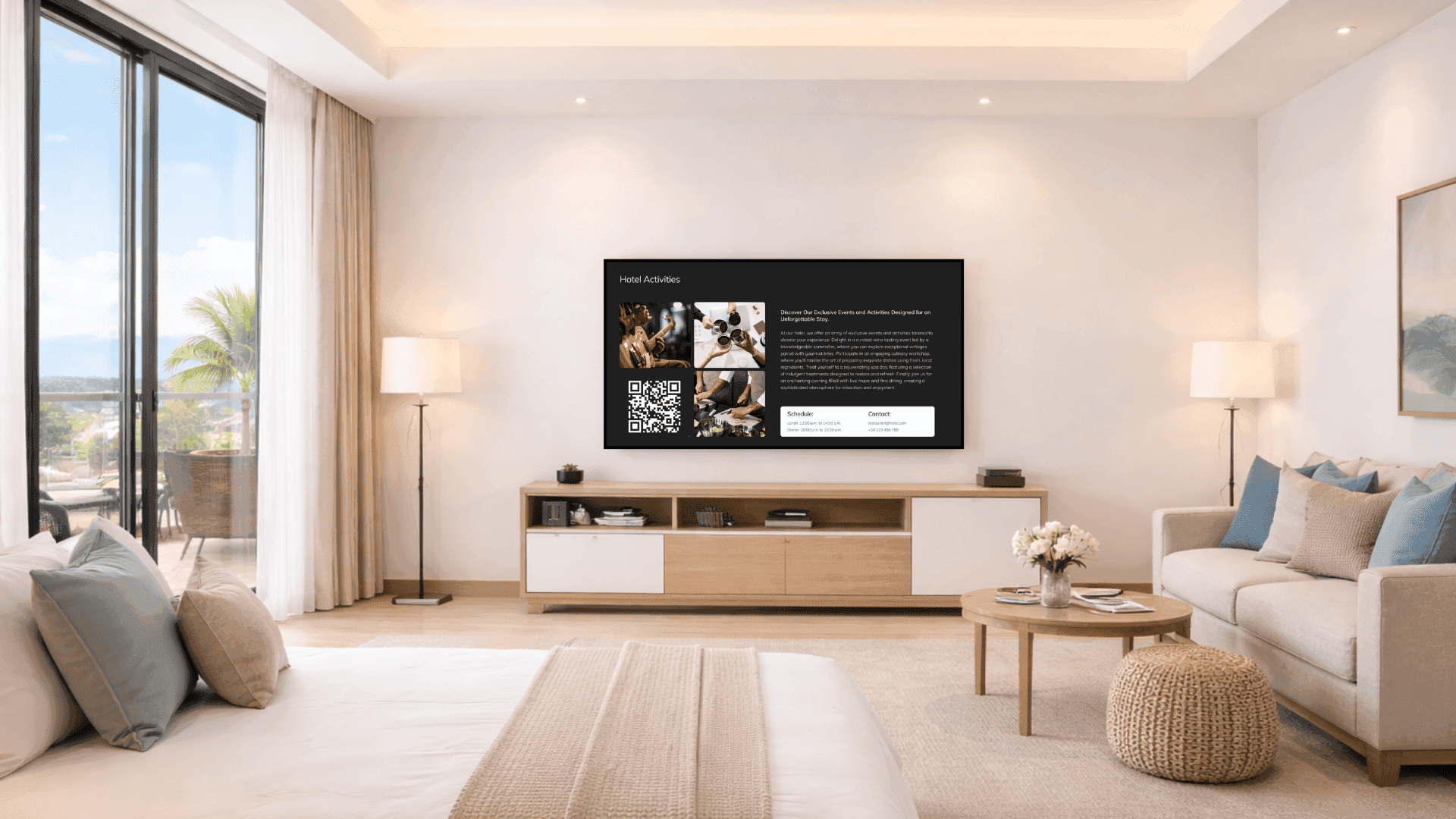
For years, “feeling at home” in a hotel meant something fairly simple: comfort and familiarity. A good bed, a decent shower, reliable Wi-Fi, and a TV that didn’t require wrestling with three different remote controls.
In 2026, that idea becomes far more demanding — and far more interesting. Feeling at home will mean having control, digital continuity, meaningful personalisation and trust… all without friction, without intrusion, and without adding operational burden to hotel teams.
The industry is not moving towards more screens or more apps. It is moving towards adaptive experiences: stays that behave like a good host — understanding context, anticipating needs with discretion, and resolving requests in real time. All of this is unfolding within an increasingly rigorous framework for privacy and cybersecurity across Europe.
What follows is a deep 2026 outlook: what is driving this shift, which concrete practices will become standard, and which decisions hoteliers should be making today to stay ahead.
1. “Feeling at home” is no longer about aesthetics: it’s about control and continuity
At home, users don’t learn a system. They simply do things: stream content, adjust the lighting, check information, make a purchase, ask for help. In many hotels, however, digital experiences are still designed like instruction manuals.
In 2026, the winning hotels will be those that turn the stay into a natural flow:
“Instant access to entertainment and hotel content, without risky or unprotected logins on the TV.”
“Clear, useful information — services, opening hours, maps, local experiences, room service — without scattered leaflets across the room.”
“One-click actions from a single interface: booking the spa, requesting late checkout, ordering amenities, and more.”
“Language and tone adapted to the guest context — families, corporate travellers, leisure guests, international visitors.”
This reflects a fundamental shift: the goal is not to digitalize for the sake of it, but to remove micro-frictions. And that impact is measurable — fewer repetitive calls to reception, higher upsell conversion, better guest ratings and fewer operational incidents.
2. The New Normal: Practical AI (and an Increasingly Agentic Future)
2026 is the year the conversation shifts from AI as a promise to AI as an operational layer. We are no longer talking only about recommendations; we are talking about agents that execute tasks and coordinate systems — PMS, payments, guest communications, revenue and operations.
What does this mean in practical terms for a hotel?
“Operations: automating repetitive tasks such as standard replies, common requests and priority assignment.”
“Revenue: offers that adapt to occupancy, guest profile, timing and in-stay behaviour — not just pre-arrival.”
“Guest experience: contextual recommendations based on real situations (“it’s raining today”, “you’re travelling with children”, “you have an early flight”, “you arrived late”).”
But there’s an important caveat. AI that works in hospitality is not the one that talks the most — it’s the one that reduces workload and avoids mistakes. Achieving that requires:
Clean, reliable data
Clear business rules
Well-structured content
And a design where humans remain in control, with full visibility for hotel teams
3. The Room Becomes a Hub (and the TV Returns to the Centre)
There is a reason why the sense of “feeling at home” is so often decided inside the guest room: this is where guests let their guard down. When digital experiences feel effortless at the moment of rest, hotels earn trust — and unlock real service opportunities.
In 2026, the TV is no longer just entertainment. It becomes an interface: the place where guests understand the hotel and take action. And most importantly, it is an interface that requires no app downloads or installations.
Two clear accelerators are shaping this shift:
3.1. Secure casting
The industry is moving towards solutions where guests connect via QR code, with sessions isolated by room and automatically closed at checkout — avoiding the all-too-common “I forgot to log out of Netflix” scenario.
3.2. From “Smart TV” to immersive, connected experiences
Interactive entertainment and unified experiences — combining content and services — are turning the stay into something intuitive and natural, rather than fragmented or forced.
The real opportunity for hoteliers is not adding more features. It is this: making sure the guest doesn’t have to think — and the team doesn’t have to chase requests.
4. Personalization That Actually Matters: Micro-Moments, Not Artificial “Wow”
In 2026, effective personalization is built around three core principles:
4.1. Stay context, not data for data’s sake
A corporate guest arriving late on a Tuesday for one night has very different needs from a family staying five nights in August with children and a pool on the agenda. That difference should be reflected in what the hotel shows, recommends and offers.
4.2. High-impact micro-moments
Personalisation delivers the most value when it appears at the right moments:
Arrival: orientation and essential services.
First night: light dining options, room service, rest.
First morning: breakfast, gym access, late checkout.
Last night: transport, billing, timely reminders.
4.3. Silent personalization
There is no need to announce, “this has been personalised for you.” Guests feel it. And when they do, perceived quality increases.
This approach reflects a recurring insight across 2026 industry outlooks: technology should enhance the human experience — not replace it.
5. “Feeling at Home” Also Means Peace of Mind: Privacy as a Purchase Criterion
In Europe, 2026 marks a turning point: hoteliers can no longer treat security and privacy as “the Wi-Fi provider’s problem.” With NIS2, the security approach becomes stricter and broader, pushing the industry towards more mature processes for risk management, incident response and technology supply-chain governance.
Translated into practical decisions, this raises key questions:
How are devices isolated at room level?
What happens to sessions — casting, apps, browsing — at checkout?
Who has access to what, and how is that access audited?
Are there remote updates, SLAs, logs and a defined incident-response process?
One important nuance stands out: privacy is no longer just about GDPR compliance. It is a matter of brand trust. And when guests perceive risk, the sense of “feeling at home” quickly breaks down.
6. The New Luxury Is Time (and Automation Becomes a Service)
Talent shortages and operational pressure will not disappear in 2026. That is why the automation that truly succeeds is not the one that adds more technology, but the one that gives time back to hotel teams — so they can focus on hospitality.
In practice, we will see growth in:
Well-designed self-service (without forcing it): requests, information, upgrades.
Messaging integrated into operations, not treated as a standalone channel.
Process standardisation through templates, workflows and clear priorities.
Usage analytics to remove what no one uses — and strengthen what actually delivers value.
The question that separates useful projects from endless pilots is simple:
Which task stops being done manually from day one?
7. Distribution and Direct Relationships: From Traffic to Connection
In 2026, the battle is no longer just for bookings — it is for relationships. Guest behaviour increasingly follows a “two-step” pattern: travellers research on OTAs, then book directly when a hotel offers confidence, control and clarity.
This is where “feeling at home” also comes into play. Guests who experience continuity and genuine care during their stay are more likely to:
return,
recommend the hotel,
and become less price-sensitive.
For hoteliers, this is a critical shift. The in-stay experience is no longer post-sale — it is real-time brand building.
8. Experiences Become More Immersive — but with Purpose
The experience economy continues to grow, but it is maturing. Fewer fireworks, more authenticity and wellbeing. 2026 outlooks point to immersive experiences, wellness and a more regenerative approach — centred on people, place and planet.
For hotels, this translates into:
Curated local content, not generic “10 places from TripAdvisor” lists.
True rest experiences — focused on sleep quality, silence and restorative routines.
Coherence across the journey, where digital tools support the experience rather than distract from it.
9. What Hoteliers Should Be Doing in 2026
If your goal is for guests to say “I felt at home,” in 2026 it won’t be enough to invest — you need to prioritize wisely. Here’s a practical framework:
9.1. Design your “Home Flow” in five minutes
What should guests be able to do in their room, without assistance?
Connect: Wi-Fi and secure casting.
Understand the hotel: clear services and information.
Request: three core actions that matter most.
Resolve: a real, helpful FAQ — not corporate copy.
Close the stay: checkout and transport.
9.2. Unify the interface: one central touchpoint
The more you spread the experience across apps, leaflets and screens, the more friction you create. In 2026, centralization wins.
9.3. Personalise with boundaries
Don’t try to personalize everything. Choose six to eight micro-moments and make them flawless.
9.4. Security as part of the guest experience
Guests don’t want to hear about VLANs — but they do want to know that nothing “strange” will happen to their accounts or their privacy.
9.5. Measure what truly matters
Forget endless dashboards. Focus on:
usage rates per screen or function,
reduction in repetitive front-desk calls,
upsell conversion,
NPS and guest feedback linked to friction points (Wi-Fi, TV, information).
In 2026, “feeling at home” will mean “feeling like me.”
The future of “feeling at home” is not about recreating a living room. It is about recreating a feeling: effortless control.
The 2026 guest is not asking for more technology — they are asking the hotel to adapt to their rhythm. And the hoteliers who achieve this will not only elevate the guest experience; they will gain efficiency, trust and revenue in the same move.
Industries
Hospitality
IPTV/OTT operators
Content owners
Sports platforms
Contact
info@yuvod.com
